



Yes, our inventory is accurate!
 Qualifies for Free Ground Economy Shipping (CONUS Only)
APS-C mono imaging with the guide camera built in
Why we like the ASI2600MM DUO:
- One camera instead of three parts: the same 26MP IMX571 mono sensor as the ASI2600MM Pro, with an SC2210 guide sensor (the one in the ASI220MM Mini) sitting just beside it. There's no off-axis guider, guide camera or guide scope to buy, mount or balance.
- Guiding through your telescope: the guide sensor sees through the main optics like a built-in off-axis guider, so there's no flexure between a guide scope and the imaging scope on long narrowband subs.
- Works with the software you already use: it's a regular USB camera, not a smart camera, so it runs from a computer or an ASIAIR. That's the main difference from the ASI2600MM Air, which has the ASIAIR built in.
- Worth knowing: the guide sensor sits off center, so you need a telescope with a full-frame image circle and 2-inch filters. Narrowband filters also dim the guide stars, and a separate guide camera would be faster to replace if anything ever needs service.
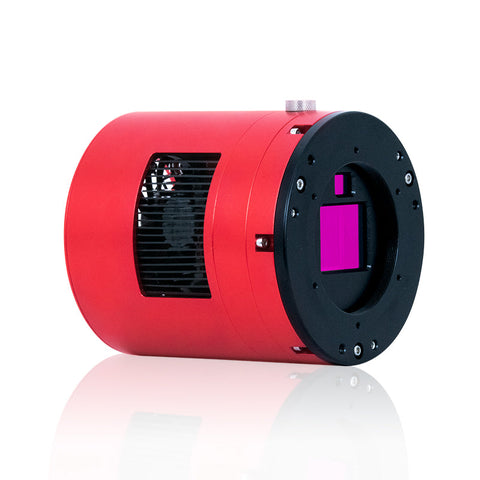
The ZWO ASI2600MM DUO is a cooled monochrome deep-sky camera that puts an imaging sensor and a guide sensor in one 90mm body. The main sensor is Sony's 26MP back-illuminated APS-C IMX571 with a 16-bit ADC, about 91% peak QE and zero amp glow. The guide sensor is a 2MP SC2210 with 0.6e⁻ read noise and 92% peak QE. One USB 3.0 cable runs both. It's for imagers ready for LRGB and narrowband who want a long-focal-length guiding setup without an OAG and guide camera. The camera weighs 715g (1.58lb).
Key specs: Sony IMX571 APS-C mono sensor (23.5 × 15.7mm) · 26MP (6248 × 4176) · 3.76µm pixels · 91% peak QE · 16-bit ADC, up to 14 stops dynamic range · read noise 0.9–4.2e⁻ · built-in SC2210 guide sensor (1920 × 1080, 4µm) · cooling 30–35°C below ambient · zero amp glow · USB 3.0 with 512MB buffer · 715g

What you can image
- Large nebulae in narrowband: the North America and Pelican, Heart and Soul, Veil, California and Rosette Nebulae in hydrogen-alpha, OIII and SII. On the 250mm RedCat 51 the field is about 5.4° × 3.6° at 3.1″ per pixel.
- Nebula detail: the Eagle's Pillars, the Elephant's Trunk, the Crescent and the Cygnus Wall. On the 612mm ZWO FF90 the field is about 2.2° × 1.5° at 1.3″ per pixel.
- Galaxies in LRGB: the Andromeda and Triangulum Galaxies, M81 and M82, the Leo Triplet and the Whirlpool. On the 770mm FF110 the field is about 1.75° × 1.2° at 1.0″ per pixel, and the guide sensor works at about 1.1″ per pixel, which is where a built-in guider earns its keep.
- Faint outer structure: the high QE and low noise suit long integrations on targets like the Squid Nebula (Ou4) in OIII or the faint dust around M81.
How it works
The main sensor records the image through your filters while the guide sensor, about 18mm off center, watches a star at the edge of the same light cone and sends corrections to the mount. Both sensors share one USB 3.0 cable to your computer or ASIAIR Plus, and two USB 2.0 ports on the back power and control a filter wheel and focuser. The cooler needs 12V (ZWO specifies 12V at 3–5A, 5.5 × 2.1mm plug, center positive).
A knob on the side focuses the guide sensor separately, so you can make the guide stars sharp once the main camera is in focus. The sensor sits 17.5mm behind the front of the removable 5mm M54 tilt plate, and the included 16.5mm and 21mm M54 extenders bring that to the standard 55mm most flatteners and reducers expect. A 2-inch filter wheel takes the place of part of that spacing. Three push-pull screws on the back adjust tilt without taking the camera off the scope.
ZWO's drawing places both sensors inside a 44mm circle, so choose a telescope sold as full-frame compatible, such as the ZWO FF quadruplets. On scopes with a smaller image circle, or with reducers at the wrong spacing, stars in the guide sensor's corners may not be round. ZWO notes that this doesn't affect normal guiding.
Using it in Colorado
- Front Range skies: narrowband filters cut through city light, so emission nebulae are fair game from Denver, even with the Moon up. Save LRGB galaxies for darker sites like Jackson Lake State Park or the Westcliffe area.
- Cold nights: the cooler holds a set temperature as the night cools, and the heated window keeps frost off. ZWO rates the camera for −5°C to 50°C, so on the coldest winter nights keep an eye on it.
What to add for the best results
- A 2" filter wheel (required for color): the ZWO EFW 7x2" (2025) holds LRGB plus Ha, OIII and SII; the EFW 5x2" (2025) holds LRGB plus Ha. Both plug into the camera's USB ports. The filters sit in front of the guide sensor too, so 36mm and 1.25" wheels are too small.
- Narrowband filters: the ZWO 7nm SHO set or the Optolong SHO 7nm set, in the 2" size.
- LRGB filters: the Optolong LRGB set or ZWO LRGB set in 2", for galaxies and star clusters in natural color.
- 12V power (required for cooling): the ZWO 12V 5A adapter at home, or a PowerTank Lithium Pro in the field.
- ZWO EAFN electronic focuser: refocuses automatically between filters and as the temperature drops.
- ASIAIR Plus: runs the camera, guiding, filter wheel, focuser and mount from your phone, if you'd rather not bring a laptop.
- A full-frame telescope and a mount: the ZWO FF90 or FF110 on a ZWO AM5N.
ASI2600MM DUO vs. ASI2600MM Pro vs. ASI2600MM Air vs. ASI2600MC DUO
| ASI2600MM DUO | ASI2600MM Pro (2025) | ASI2600MM Air | ASI2600MC DUO | |
|---|---|---|---|---|
| Main sensor | IMX571 mono, APS-C | IMX571 mono, APS-C | IMX571 mono, APS-C | IMX571 color, APS-C |
| Peak QE | 91% | 91% | About 91% | 80% |
| Guiding | Built-in guide sensor | Separate OAG and guide camera | Built-in guide sensor | Built-in guide sensor |
| Controller | Computer or ASIAIR | Computer or ASIAIR | Built-in ASIAIR, 256GB | Computer or ASIAIR |
| Filters needed | 2" filter wheel and filters | Filter wheel and 36mm or 2" filters | 2" filter wheel and filters | None (2" dual-band optional) |
| Image circle needed | Full frame (about 44mm) | About 28mm or more | Full frame (43mm) | Full frame (about 44mm) |
| Price | $2,299 | $1,999, about $2,426 with an OAG and ASI220MM Mini | $2,499 | $1,799 |
| Best for | Mono with built-in guiding and your own software | Smaller filters, shorter scopes, choosing each part | The fewest boxes and cables at the scope | Color in one shot with built-in guiding |
See all ZWO cooled deep-sky cameras.
What's in the box

- ASI2600MM DUO camera and camera bag
- USB 3.0 cables (2m and 0.75m) and two USB 2.0 cables (0.5m)
- M54 extenders (16.5mm and 21mm) and an M54-M48 adapter
- Hex wrench and quick guide
ZWO's box photo shows the color MC DUO; the MM DUO ships with the same accessories. The 12V power supply, filter wheel, filters, telescope and mount are sold separately.
ZWO ASI2600MM DUO FAQ
Is the ASI2600MM DUO good for beginners?
It's best as a second camera, once you're comfortable with focusing, guiding and stacking. Mono imaging means a filter wheel, filters and combining channels in processing. If you're starting out, the color ASI2600MC DUO keeps the built-in guiding and skips the filters.
ASI2600MM DUO or ASI2600MM Pro with an OAG?
The DUO costs about $125 less than an ASI2600MM Pro, a ZWO OAG and an ASI220MM Mini, and there's nothing to space or align between them. The Pro makes sense if your telescope's image circle is smaller than full frame, you want to use 36mm filters, or you already own a guider.
ASI2600MM DUO or ASI2600MM Air?
They share the same main and guide sensors. The MM Air adds a built-in ASIAIR with 256GB of storage and Wi-Fi for $200 more. Choose the DUO if you run NINA, SharpCap or another program on a computer, or already own an ASIAIR.
What size filters do I need?
2" filters. The filter sits in front of both sensors, and the guide sensor is about 18mm off center, outside what 36mm and 1.25" filters cover.
Can it guide through narrowband filters?
Yes, but narrowband filters dim the guide stars too. The SC2210's high sensitivity helps, and a fast telescope and slightly longer guide exposures make it easier.
What telescope works best?
A refractor with a full-frame image circle and the standard 55mm back focus, such as the ZWO FF90 or FF110. The built-in guider is most useful from about 500mm focal length up.
Specifications
| Main sensor | |
|---|---|
| Sensor | Sony IMX571, back-illuminated, monochrome |
| Format | APS-C, 23.5 × 15.7mm (28.3mm diagonal) |
| Resolution | 26MP, 6248 × 4176 |
| Pixel size | 3.76µm |
| ADC | 16-bit |
| Read noise | 0.9–4.2e⁻ (1.3e⁻ at gain 100) |
| Full well | 50,000e⁻; up to 73,000e⁻ in extended mode (gain −25) |
| Dynamic range | Up to 14 stops |
| Peak QE | About 91% |
| Amp glow | None |
| Max frame rate | 15 fps at full resolution (8-bit high-speed mode); 6.1 fps at 16-bit |
| Exposure range | 32µs to 2000s |
| Guide sensor | |
| Sensor | SC2210, mono, 1/1.8" (7.68 × 4.32mm) |
| Resolution | 2MP, 1920 × 1080, 4µm pixels |
| Read noise | 0.6–3.2e⁻ |
| Full well | 8,780e⁻ |
| Peak QE | 92% at 500nm |
| ADC | 12-bit |
| Focus | Separate guide-sensor focus knob |
| Cooling and electronics | |
| Cooling | Two-stage TEC, 30–35°C below ambient (tested at 30°C ambient) |
| Anti-dew | Polyimide heater on the protective window, switchable in software |
| Protective window | AR-coated, 60mm × 2mm |
| Data | USB 3.0 (one cable for both sensors), 512MB DDR3 buffer |
| Hub | 2 × USB 2.0 on the camera body |
| Power | 12V DC, 3–5A, 5.5 × 2.1mm center positive (supply not included); 27.5W maximum |
| Software | Windows, Linux and macOS; ASIAIR |
| Physical | |
| Front connection | M54 × 0.75 on a removable 5mm tilt plate |
| Tilt adjustment | Tilt plate plus three push-pull screws on the back |
| Back focus | 17.5mm; 55mm with the included extenders |
| Image circle | Full frame recommended (both sensors fit within 44mm) |
| Size | 90mm diameter × 97mm long |
| Weight | 715g (1.58lb) |
| Operating temperature | −5°C to 50°C |
| Warranty | 2 years (ZWO) |
| Model / SKU | ZWO-ASI2600MM-Duo |