
Schmidt-Cassegrain Telescopes (SCT)
Schmidt-Cassegrain telescopes (SCTs) pack a large aperture and long focal length into a short, portable tube, which makes them the most popular all-around telescope for serious amateur astronomers. They excel on the Moon and planets, show galaxies and nebulae well, and adapt to astrophotography with focal reducers or HyperStar.
Shop by type: NexStar SE (computerized, easy to set up) · NexStar Evolution (Wi-Fi, built-in battery) · EdgeHD (flat-field optics for astrophotography) · Optical tubes only · Used SCTs
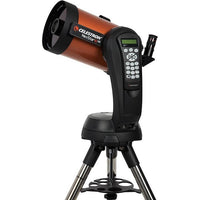
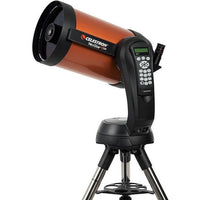
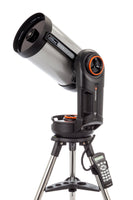

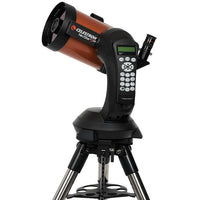

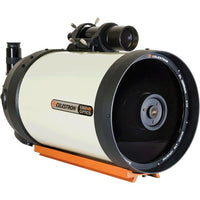
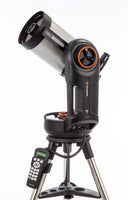


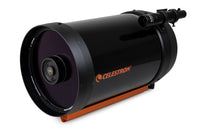
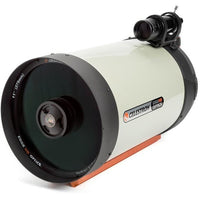
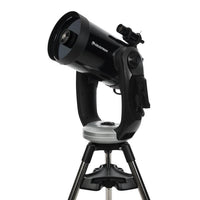
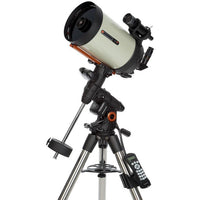
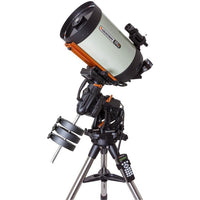
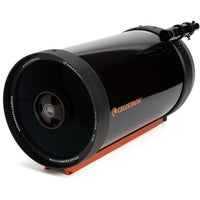
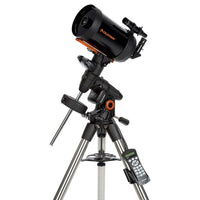
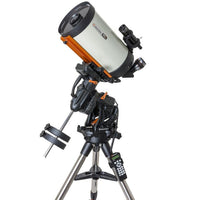
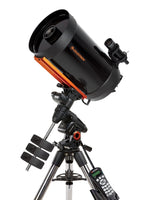
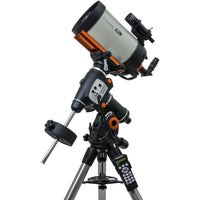
Schmidt-Cassegrain telescope buying guide
What is a Schmidt-Cassegrain telescope?
A Schmidt-Cassegrain telescope (SCT) combines a spherical primary mirror, a thin corrector plate at the front of the tube and a small convex secondary mirror. The light path folds back on itself, so a long focal length fits in a very short tube: an 8-inch SCT has a 2032mm focal length in a tube only about 17 inches long. That makes SCTs powerful yet portable, and the closed tube keeps the optics clean.
Standard SCT or EdgeHD?
For visual observing, they perform essentially the same. EdgeHD models add a set of corrector lenses in the baffle tube that flatten the field, so stars stay pinpoint all the way to the edge of a large camera sensor. They also add mirror locks and a dedicated 0.7x reducer. Choose EdgeHD if deep-sky imaging with a larger sensor is a priority; choose a standard SCT for visual observing, planetary imaging and HyperStar imaging, and save the difference.
Which aperture?
| Aperture | Focal length | Good for | Examples |
|---|---|---|---|
| 5" | 1250mm | Grab-and-go, travel, the Moon and planets | NexStar 5SE, StarSense Explorer DX 5" |
| 6" | 1500mm | A light first computerized scope with real deep-sky reach | NexStar 6SE, Evolution 6 |
| 8" | 2032mm | The sweet spot: detailed planets, many galaxies, still easy to carry | NexStar 8SE, Evolution 8, C8 tube |
| 9.25" | 2350mm | Sharper planetary detail; a favorite for planetary imaging. A great balance of size and light grasp. | Evolution 9.25, C9.25 tube |
| 11" | 2800mm | Maximum size that one able-bodied person can still set up. (May prove too bulky for some people.) | C11 tube, EdgeHD 11 |
Bigger shows more, but only if it gets used. If you'll carry the scope out on a whim after work, an 8" or smaller is usually the best choice.
Complete telescope or optical tube only?
A complete telescope includes a matched computerized mount. NexStar SE models use a simple single-arm mount that's quick to set up and great for visual observing. NexStar Evolution models add built-in Wi-Fi control, a rechargeable battery and sturdier gearing. Equatorial packages like the Advanced VX, CGEM II and CGX are built for long-exposure astrophotography.
An optical tube (OTA) lets you choose your own mount. Modern strain-wave mounts are an excellent match: a Sky-Watcher Wave 100i or ZWO AM5N for a C8, and a Sky-Watcher Wave 150i or ZWO AM7 for a C9.25 or C11. We recommend using a counterweight with any strain-wave mount, since an SCT's weight sits well out from the mount.
Visual observing or astrophotography?
Any SCT is superb on the Moon and planets, visually or with a planetary camera. For deep-sky imaging, the native f/10 focal ratio is slow, so most imagers add an f/6.3 reducer (or the 0.7x reducer on EdgeHD), or use HyperStar to image at f/2 on Fastar-compatible models. Long-exposure imaging also calls for an equatorial or strain-wave mount rather than an alt-azimuth one.
What about Meade?
Meade Instruments ceased operations in 2024, so new Meade SCTs and factory parts are no longer available. We occasionally have used SCTs, including Meade models, and every used telescope is checked in person at our Denver store.
Schmidt-Cassegrain FAQ
Are SCTs good for beginners?
Yes. A computerized SCT like the NexStar 6SE or 8SE finds and tracks objects for you, and the compact tube is easy to handle. They're one of the most popular first "serious" telescopes.
SCT or Dobsonian?
A Dobsonian gives more aperture per dollar but is bulkier and usually manual. An SCT costs more per inch of aperture but is far more compact, tracks the sky and doubles as an imaging platform.
SCT or Maksutov-Cassegrain?
Both are compact folded designs. Maksutovs are simpler and hold collimation well but top out at small apertures and cool down slowly. SCTs scale up to 8", 11" and beyond.
Why do SCTs need time to cool down?
The closed tube traps warm air, which blurs the view until the mirror matches the outside temperature. Set up 30 to 60 minutes before serious planetary viewing, especially with 8" and larger scopes.
Do I need a dew shield?
Yes, we recommend a dew shield. The corrector plate at the front of the tube dews up easily, especially in humid conditions. Even in dryer conditions, the dew shield blocks stray light, helping your view.
Can I use 2-inch eyepieces?
Yes, on 8" and larger SCTs, you can add a 2" SCT visual back and 2" diagonal in place of the 1.25" accessories supplied with most SCTs. Celestron and others also offer 2" Diagonals with SCT threaded connectors directly. Note that the physical size of the optical tube on the 6" and smaller SCT do not accommodate a 2" Diagonal. The value on a 8" SCT is also limited by the light path in the telescope, so you cannot take full advantage of low power, wide field 2" eyepieces. A 2" Diagonal comes into its own with the 9.25 and larger SCTs.