



Yes, our inventory is accurate!
 Qualifies for Free Ground Economy Shipping (CONUS Only)
The APS-C mono camera for deep narrowband and LRGB images on almost any refractor
Why we like the ASI2600MM Pro:
- A big, sensitive sensor that most scopes can cover: the 23.5 × 15.7mm APS-C IMX571 has 91% peak QE and frames about 5.4° × 3.6° on a 250mm RedCat, yet it only needs a 28mm image circle and 36mm filters, not the full-frame optics and 2-inch filters of the ASI6200MM.
- Clean data, night after night: zero amp glow, a true 16-bit ADC with up to 14 stops of dynamic range, and dark current so low at 0°C that a 5-minute sub adds less noise than the camera's own read noise.
- Easier to set up than before: the 2025 model adds a built-in tilt plate, so you can square the sensor to your optics if stars in one corner aren't round, and a heated window keeps dew and frost off.
- Worth knowing: mono means a filter wheel, filters and more processing time. Owners of the earlier ASI2600MM Pro generally don't need to upgrade, since the sensor is the same. You'll also need 12V power and a computer or ASIAIR to run it.
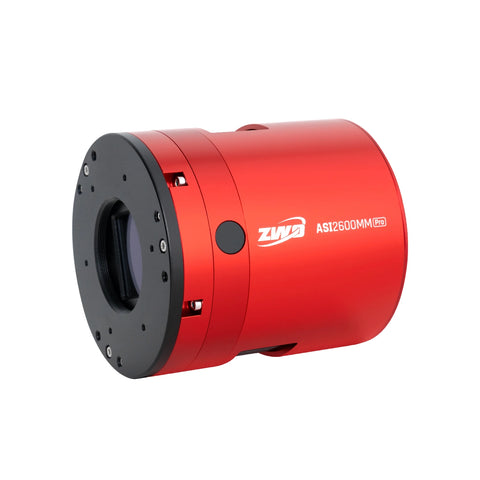
The ZWO ASI2600MM Pro (2025 model) is a cooled monochrome astronomy camera built on Sony's 26MP back-illuminated APS-C IMX571 sensor. It's a natural next step for imagers who are ready to move from color to narrowband and LRGB, and it suits refractors from about 250 to 1000mm. Two-stage cooling holds the sensor about 35°C below ambient, and at gain 100 a high-conversion-gain mode drops read noise to about 1.3e⁻ while keeping dynamic range high. The body weighs 0.7kg (1.54lb).
Key specs: Sony IMX571 APS-C mono sensor, 23.5 × 15.7mm · 26MP (6248 × 4176) · 3.76µm pixels · 91% peak QE · 16-bit ADC, up to 14 stops dynamic range · read noise 1.0–3.3e⁻ · 73,000e⁻ full well · 14.3 fps · cooling 30–35°C below ambient · zero amp glow · USB 3.0 with 512MB buffer · tilt plate · 0.7kg (1.54lb)

What you can image
- Large nebulae in narrowband: the North America and Pelican, Heart and Soul, Veil, California and Rosette Nebulae in hydrogen-alpha, OIII and SII. On a 250mm RedCat 51 the field is about 5.4° × 3.6° at 3.1″ per pixel.
- Nebula detail: the Eagle's Pillars, the Elephant's Trunk, the Crescent and the Cygnus Wall on a longer refractor. On the 612mm ZWO FF90 the field is about 2.2° × 1.5° at 1.3″ per pixel.
- Galaxies in LRGB: the Andromeda and Triangulum Galaxies, M81 and M82 together, the Leo Triplet and the Whirlpool. On the 770mm FF110 the field is about 1.75° × 1.2° at 1.0″ per pixel.
- Faint outer structure: the high QE and low noise suit long integrations on faint targets like the Squid Nebula (Ou4) in OIII or the integrated flux nebulae around M81.
How it works
A mono camera records every pixel at full sensitivity and leaves color to filters. A filter wheel in front of the camera switches filters during the night, and software combines each filter's frames into a color image. The camera connects to a computer or an ASIAIR Plus over USB 3.0 and runs its cooler from 12V (ZWO specifies 12V at 3–5A, 5.5 × 2.1mm plug, center positive). Two USB 2.0 ports on the camera body power and control the filter wheel and guide camera, which keeps cables short at the scope.
The sensor sits 17.5mm behind the front of the camera, and the included extenders bring that to the standard 55mm most flatteners and reducers expect. With a filter wheel, the wheel takes the place of the extenders: ZWO's chart below shows the stacks for a 36mm or 2-inch wheel with an off-axis guider. The tilt plate on the front adjusts with the included hex wrench.

Using it in Colorado
- Front Range skies: narrowband filters cut through city light, so emission nebulae are fair game from Denver on any clear night. Save LRGB galaxies for darker sites like Jackson Lake State Park or the Westcliffe area.
- Moonlit nights: hydrogen-alpha is barely affected by the Moon, which turns nights most color imagers lose into productive ones.
- Cold, dry nights: the cooler holds a set temperature as the night cools off, and the heated window (about 5W, switchable in software) keeps frost off the sensor window on winter nights.
What to add for the best results
- A filter wheel (required for color): the ZWO EFW 7x36mm (2025) is the natural match for APS-C, holding a full LRGB and SHO set in a compact 20mm-thick wheel. If you might move up to full frame later, choose the EFW 7x2" (2025) or the smaller EFW 5x2" (2025). Avoid 1.25-inch wheels and filters; they vignette this sensor.
- Filters (required for color): the Optolong LRGB + SHO 7nm set comes in 36mm unmounted or 2" to fill a 7-position wheel, or start with the ZWO 7nm SHO set in 2" for narrowband. The ZWO LRGB set in 2" adds broadband color.
- 12V power (required for cooling): the ZWO 12V 5A adapter at home, or a PowerTank Lithium Pro in the field.
- ZWO Large OAG (12mm prism) with an ASI220MM Mini guide camera: guides through the main telescope, which suits longer focal lengths. A guide scope works well on shorter refractors.
- ZWO EAFN electronic focuser: refocuses automatically after filter changes and as the temperature drops.
- ASIAIR Plus: runs the camera, filter wheel, mount, guiding and focuser from your phone, including multi-filter sequences.
- A mount: the ZWO AM5N carries this camera, a filter wheel and a refractor up to about 110mm with room to spare.
ASI2600MM Pro vs. ASI2600MC Pro vs. ASI2600MM Air vs. ASI6200MM Pro
| ASI2600MM Pro (2025) | ASI2600MC Pro (2025) | ASI2600MM Air | ASI6200MM Pro (2025) | |
|---|---|---|---|---|
| Sensor | IMX571 mono, APS-C | IMX571 color, APS-C | IMX571 mono, APS-C | IMX455 mono, full frame |
| Resolution | 26MP | 26MP | 26MP | 62MP |
| Peak QE | 91% | 80% | 91% | 91% |
| Built-in ASIAIR and guide sensor | No | No | Yes | No |
| Filters needed | 36mm or 2" filters and a filter wheel | None (dual-band optional) | 36mm or 2" filters and a filter wheel | 2" filters and a filter wheel |
| Image circle needed | About 28mm or more | About 28mm or more | About 28mm; ZWO recommends full frame for the best guiding | About 44mm or more |
| Best for | Mono imaging on most refractors, with any control software | Color in one shot, with the simplest setup | Mono with the fewest cables and boxes at the scope | The widest field and most resolution, on a full-frame scope |
See all ZWO cooled deep-sky cameras.
What's in the box

- ASI2600MM Pro camera body, front cover and camera bag
- M42-M48 extender (16.5mm), M42 extender (21mm) and M42-M48 adapter
- USB 3.0 cable (2m) and two USB 2.0 cables (0.5m)
- Hex wrench and quick guide
The 12V power supply, filter wheel, filters and guide camera are sold separately.
ZWO ASI2600MM Pro FAQ
Is the ASI2600MM Pro good for beginners?
It's best as a second camera, after you've learned focusing, guiding and stacking with a color camera. If this is your first dedicated astro camera, we usually suggest the ASI2600MC Pro, which uses the same sensor in color.
Mono (MM) or color (MC)?
Choose the MC Pro for color images in one shot and a simpler setup. Choose the MM Pro to shoot narrowband from the city or chase the most detail and signal, if you're ready to add a filter wheel and filters.
ASI2600MM Pro or ASI2600MM Air?
The MM Air has the same sensor plus a built-in ASIAIR, a guide sensor and Wi-Fi, so it replaces three devices and most of the cables. The MM Pro costs less, works with any computer software, and lets you choose and upgrade the controller and guider separately.
ASI2600MM Pro or ASI6200MM Pro?
Both use 3.76µm pixels, so detail per pixel is the same. The ASI6200MM Pro covers 2.3 times the sky area but needs a full-frame image circle and 2-inch filters, and costs about twice as much. The ASI2600MM Pro works with more telescopes and smaller filters.
Which filters and filter wheel do I need?
36mm unmounted filters in the EFW 7x36mm, or 2-inch mounted filters in a 2-inch wheel. A common set is luminance, red, green and blue plus hydrogen-alpha, OIII and SII, which fills a 7-position wheel exactly. 1.25-inch filters are too small for this sensor.
Should I upgrade from my older ASI2600MM Pro?
Usually not. The sensor is the same. The 2025 model adds the tilt plate, which is handy if your current setup shows tilt, and ZWO now rates its full well at 73,000e⁻.
Specifications
| Sensor | |
|---|---|
| Sensor | Sony IMX571, back-illuminated, monochrome |
| Format | APS-C, 23.5 × 15.7mm (28.3mm diagonal) |
| Resolution | 26MP, 6248 × 4176 |
| Pixel size | 3.76µm |
| ADC | 16-bit |
| Read noise | 1.0–3.3e⁻ |
| Full well | 73,000e⁻ |
| Dynamic range | Up to 14 stops |
| Peak QE | 91% |
| Amp glow | None |
| Performance | |
| Cooling | Two-stage TEC, 30–35°C below ambient (35°C measured at 30°C ambient) |
| Max frame rate | 14.3 fps at full resolution |
| Dark current | 0.0022e⁻/s/pixel at 0°C; 0.00012e⁻/s/pixel at −20°C |
| Recommended gain | 0 or 100 (high-conversion-gain mode turns on at 100) |
| Anti-dew | Heated protective window (about 5W, switchable) |
| Physical and connections | |
| Data | USB 3.0 with 512MB DDR3 buffer |
| Hub | 2 × USB 2.0 on the camera body |
| Power | 12V DC for cooling, 3–5A, 5.5 × 2.1mm center positive (supply not included) |
| Back focus | 17.5mm; 55mm with included extenders |
| Front connection | M42 × 0.75 on the 5mm tilt plate; included extenders and adapter fit M42 and M48 telescope threads. ZWO also offers M48, M54 and M68 tilt plates |
| Tilt adjustment | Built-in tilt plate |
| Size | 90mm diameter × 97mm long |
| Weight | 0.7kg (1.54lb) |
| Model / SKU | ZWO-ASI2600MM-P25 |