




Yes, our inventory is accurate!
 Qualifies Towards Free Ground Economy Shipping (CONUS Only) For Most Orders Of $149 Or More
Narrowband nebula images with the color camera you already own
Why we like the ZWO Duo-Band:
- Narrowband without the full kit: one filter passes hydrogen-alpha and OIII together, so a one-shot color camera can image emission nebulae from the city without a mono camera, filter wheel and three-filter set.
- Fights skyglow and moonlight: two windows, 15nm at Ha and 35nm at OIII, keep the nebula light and block most streetlight and moonlight.
- An easy price to start with: it's one of the lowest-cost ways into narrowband, in 1.25" for small sensors or 2" for APS-C and smart cameras.
- Worth knowing: it's for emission nebulae only. Galaxies, star clusters and reflection nebulae need broadband imaging under dark skies, so take the filter out for those.
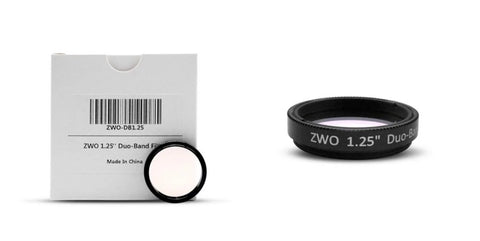
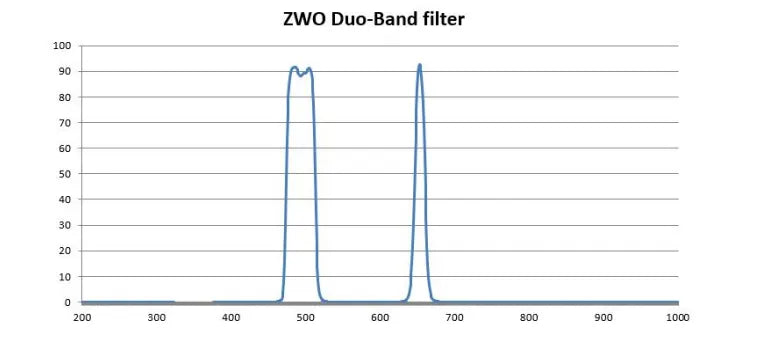
The ZWO Duo-Band Filter is a dual narrowband filter made for one-shot color (OSC) astronomy cameras. It passes the hydrogen-alpha line at 656.3nm in a 15nm band and the oxygen-III lines at 495.9 and 500.7nm in a 35nm band, and blocks the rest of the spectrum. Red pixels record the hydrogen and blue-green pixels record the oxygen, so a single exposure collects both. It threads onto ZWO cameras and filter wheels like any standard 1.25" or 2" filter, and we carry both sizes.
Key specs: Ha 656.3nm (15nm band) and OIII 495.9/500.7nm (35nm band) · over 90% transmission at OIII, over 80% at Ha · 1.85mm Schott glass · 1/4-wave polished, under 30 arc-seconds parallelism · light within 8° of perpendicular · 1.25" or 2" mounted

What you can image with it
- Bright emission nebulae from a city backyard: the Orion Nebula (M42), the Lagoon (M8), the Eagle (M16) and the Rosette, rich in hydrogen with OIII in their cores.
- Large hydrogen clouds: the Heart and Soul, the North America and Pelican, the Flaming Star and the Horsehead region, where ZWO's own test images show the faint red gas coming out of a light-polluted sky.
- Supernova remnants and planetary nebulae: the Veil and the Crescent (NGC 6888), and the Dumbbell (M27) and Ring (M57), where the OIII band brings out the blue-green shells.
- Moonlit nights: it keeps working when the Moon is up, so a color camera can image on nights that would otherwise be lost.
How it works
A color sensor has a Bayer pattern of red, green and blue pixels. With the Duo-Band in place, only light from the two bands reaches them: the red pixels see hydrogen-alpha and the green and blue pixels see OIII. Streetlights, LED glow and moonlight are spread across the spectrum, so most of that light is thrown away while the nebula's light gets through. The result is a far darker background and much stronger nebula contrast than with a clear or UV/IR-cut filter, as ZWO's ASIAIR snapshots of the Heart and Horsehead show. Process it as a normal color image, or split the channels into an HOO blend.
ZWO notes that light should reach the filter within 8° of perpendicular, so it isn't suited to wide-angle or ultra-wide camera lenses. Telescopes at about f/4 and slower are comfortably inside that limit.
Using it in Colorado
From most of the Front Range, the glow from Denver, Boulder or Colorado Springs is the biggest limit on nebula imaging. With a color camera, the Duo-Band is the simplest answer: from a Lakewood or Aurora backyard it pulls emission nebulae out of skyglow that would swamp an unfiltered image, and it keeps you imaging through the bright part of the lunar cycle.
What to add for the best results
- A color astronomy camera (required): the ZWO ASI533MC Pro (1-inch square sensor) with the 1.25" size, or the ASI2600MC Pro or ASI294MC Pro with the 2" size.
- A smart camera: the ASI2600MC Air and ASI585MC Air need the 2" size, because their built-in guide sensor sits beside the main sensor and needs a wide light path.
- ZWO M42 2" filter drawer or M54 version: holds the 2" filter in your imaging train so you can slide it in and out without losing focus.
- ASIAIR Plus: plans, captures and guides a whole night from your phone or tablet.
- ZWO EAFN electronic focuser: refocuses automatically as the temperature drops.
Compare dual-band filters for color cameras
| ZWO Duo-Band | Optolong L-eNhance | Optolong L-eXtreme | Optolong L-Ultimate | |
|---|---|---|---|---|
| Bands passed | Ha and OIII | Ha, H-beta and OIII | Ha and OIII | Ha and OIII |
| Bandwidth | 15nm Ha, 35nm OIII | Tri-band | 7nm each | 3nm each |
| Sizes | 1.25" or 2" | 1.25", 2" or Canon APS-C clip | 1.25" or 2" | 1.25" or 2" |
| Best for | Starting narrowband with a color camera at the lowest cost | Natural-looking nebula color with H-beta included | Stronger contrast under bright city skies | Maximum contrast and moonlight rejection |
See all astronomy filters. For mono cameras, the ZWO 7nm SHO set is the full three-filter route.
What's in the box
- ZWO Duo-Band filter, 1.25" or 2" mounted (the size you choose)
- Clear plastic storage case
The camera and filter drawer or wheel are sold separately.
ZWO Duo-Band Filter FAQ
Can I use it with a mono camera?
You can, but it isn't the best match: a mono camera would record Ha and OIII mixed together in one channel. With a mono camera, separate Ha and OIII filters, such as the ZWO 7nm SHO set, give you full control.
1.25" or 2"?
Choose 1.25" for sensors up to about 1 inch, like the ASI533MC Pro. Choose 2" for APS-C sensors such as the ASI2600MC Pro, for 4/3-inch sensors such as the ASI294MC Pro with fast scopes, and for the ASI2600MC Air and ASI585MC Air.
Is it good for galaxies?
No. Galaxies and star clusters shine across the whole spectrum, and this filter blocks most of it. Use it for emission nebulae and remove it, or switch to a UV/IR-cut filter like the ZWO IR Cut, for broadband targets.
Can I use it with a camera lens?
Only with longer lenses. ZWO says light should reach the filter within 8° of perpendicular, so it isn't suitable for wide-angle or ultra-wide lenses.
Duo-Band or L-eXtreme?
The Duo-Band's wider bands collect more signal per exposure and cost less. The 7nm L-eXtreme blocks more skyglow and moonlight, so it gives more contrast under very bright skies. Both work well from Denver-area backyards.
Will it fit my filter wheel?
Yes. It uses standard 1.25" and 2" threads, so it fits ZWO's 1.25" wheels like the EFW 8x1.25" and 2" wheels like the EFW 5x2", as well as ZWO 2" filter drawers.
Specifications
| Optical | |
|---|---|
| Passbands | Hydrogen-alpha 656.3nm (15nm), OIII 495.9 and 500.7nm (35nm) |
| Transmission | Over 90% at the OIII lines, over 80% at hydrogen-alpha |
| Glass | Schott substrate, 1.85mm thick |
| Surface quality | 60/40 (MIL-O-13830), 1/4-wave polished |
| Parallelism | Under 30 arc-seconds |
| Incident angle | Under 8° (not for wide-angle lenses) |
| Mechanical | |
| Sizes | Standard 1.25" or 2" mounted |
| Cell | CNC-machined aluminum, sandblasted and black anodized, laser-engraved |
| Model | |
| SKU | ZWO-DB1.25 (1.25"), ZWO-DB2 (2") |