



Yes, our inventory is accurate!
 Qualifies for Free Ground Economy Shipping (CONUS Only)
A big-sensor mono camera for sharp Moon, Sun and planet images
Why we like the ASI585MM:
- Every pixel counts: with no color filter over the sensor, each pixel records full detail, so lunar craters, sunspots and solar granulation come out crisper than with a color camera of the same pixel size.
- A large field for mosaics: the 1/1.2" IMX585 is 11.2 × 6.3mm, so the whole Moon or Sun fits in one frame on a small refractor, and lunar mosaics on an SCT need far fewer panels.
- Low noise, no glow: STARVIS 2 technology, read noise down to 0.7e⁻, 91% peak QE and zero amp glow, at up to 46.9 frames per second at full 3840 × 2160 resolution.
- Worth knowing: mono means color planets take a filter wheel and red, green and blue filters, plus extra processing. For color in one shot, the ASI585MC uses the same sensor. It's uncooled, so it isn't the right choice for long deep-sky exposures.
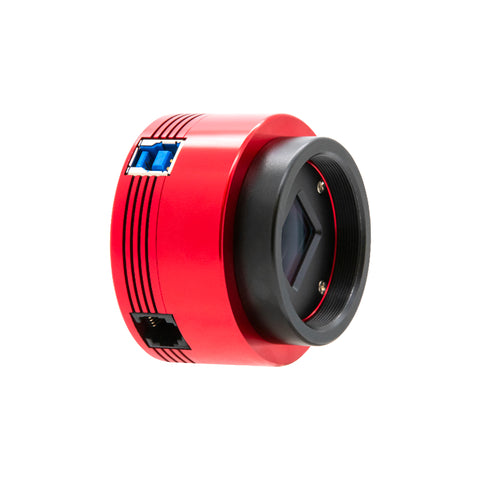
The ZWO ASI585MM is a monochrome planetary, lunar and solar camera built on Sony's 8.3-megapixel IMX585 STARVIS 2 sensor. It records high-speed video that software stacks into sharp black-and-white images of the Moon and Sun, or into color planets when you shoot through red, green and blue filters. ZWO calls it the upgrade of the ASI485, with the same 2.9µm pixels, about three times the full well and no amp glow. It's powered by USB, slides into any 1.25-inch focuser or threads onto M42 adapters, and has a 62mm body.
Key specs: Sony IMX585 STARVIS 2 mono sensor, 1/1.2" (11.2 × 6.3mm) · 8.3MP (3840 × 2160) · 2.9µm pixels · read noise 0.7e⁻ at high gain · 38.7ke⁻ full well · 91% peak QE · 46.9 fps at full resolution (12-bit) · zero amp glow · USB 3.0 with 256MB buffer

What you can capture
- The Moon: craters, rilles and mountain ranges in fine detail. On an 80mm f/6 refractor (480mm) the field is about 1.3° × 0.75°, enough for the whole Moon in one frame.
- The Sun: sunspots and granulation through a full-aperture white-light solar filter, or prominences and surface detail through a hydrogen-alpha solar telescope, where a mono camera is the usual choice.
- Planets: Jupiter's belts and Great Red Spot, Saturn's rings and the Cassini Division, and Mars near opposition, either in mono or in color with RGB filters. On an 8-inch SCT the field is about 19′ × 11′, so planets are easy to keep in frame.
- Infrared and methane views: the sensor is sensitive well into near-infrared, which ZWO says is about 1.5 times the ASI485 beyond 850nm. IR-pass filters steady the image in poor seeing.
- Bright deep-sky targets: live-stacked views of the Orion Nebula, the Ring Nebula and globular clusters like M13.
How it works
Plug the camera into a laptop's USB 3.0 port, put it in your focuser with the included 1.25" nosepiece, and record short video clips with free software such as FireCapture or SharpCap (or ZWO's ASIStudio). Stacking software like AutoStakkert! keeps the sharpest frames and combines them. No separate power supply is needed. For color planets, record a short clip through each of the red, green and blue filters and combine them after stacking.
For planets, aim for a focal ratio of about f/12 to f/15 with these 2.9µm pixels. That's an 8-inch SCT at its native f/10 with a 1.5x Barlow, or an f/6 refractor with a 2.5x Tele Vue Powermate. The sensor sits 6.5mm behind the M42 front thread (17.5mm with the 11mm T2 adapter ring in place). The ST4 port also lets it double as a guide camera.

Using it in Colorado
- Low planets: from our latitude Jupiter and Saturn can sit low in some years. An ADC and a red or IR-pass filter help the mono camera cut through the extra air.
- Daytime solar: Colorado's many clear days make solar imaging easy to fit in, but the Sun is never safe to point at without proper filtering on the front of the telescope.
What to add for the best results
- A Barlow or Powermate: the Tele Vue 2.5x Powermate or Celestron 2x X-Cel LX Barlow to reach the right image scale for planets.
- Filters and a filter wheel (for color planets): the ZWO LRGB set in 1.25" in a ZWO EFW 5x1.25" (2025), which leaves room for an IR-pass or methane filter.
- ZWO Atmospheric Dispersion Corrector: removes the smearing the atmosphere adds to planets low in the sky.
- A solar filter (required for the Sun): a full-aperture white-light filter such as an EclipSmart filter for 8" SCTs.
- A tracking mount: a ZWO AM5N or any GoTo mount that keeps the target centered while you record.
ASI585MM vs. ASI585MC vs. ASI432MM
| ASI585MM | ASI585MC | ASI432MM | |
|---|---|---|---|
| Sensor | IMX585 mono, 1/1.2" | IMX585 color, 1/1.2" | IMX432 mono, 1.1" |
| Resolution | 3840 × 2160 (8.3MP) | 3840 × 2160 (8.3MP) | 1608 × 1104 (1.8MP) |
| Pixel size | 2.9µm | 2.9µm | 9µm |
| Shutter | Rolling | Rolling | Global |
| Max frame rate | 46.9 fps | 46.9 fps | 120 fps |
| Best for | Sharp lunar, solar and planetary detail, and RGB planets | Color planets and the Moon in one shot | Hydrogen-alpha solar and fast-moving targets like the ISS |
See all ZWO planetary and all-sky cameras.
What's in the box

- ASI585MM camera
- 1.25" nosepiece
- 1.25" and 2" dust covers
- USB 3.0 cable (2m)
- ST4 guide cable
- Quick guide
Filters, Barlows, solar filters and the telescope are sold separately.
ZWO ASI585MM FAQ
Is the ASI585MM good for beginners?
For the Moon and Sun, yes: it's powered by USB, fits any 1.25" focuser, and mono images of the Moon need no filters at all. Color planets with a mono camera take filters and more processing, so if planets in color are your main goal, the ASI585MC is simpler.
Mono (MM) or color (MC)?
The MM gives sharper detail per pixel, works with hydrogen-alpha solar telescopes and IR-pass filters, and makes the best lunar images. The MC gives color planets in one shot with no filter wheel.
Which camera is best for hydrogen-alpha solar imaging?
Both mono cameras work well. The ASI585MM's large sensor covers more of the disk, while the ASI432MM's global shutter and large 9µm pixels suit slow solar telescopes and avoid the "jello" distortion a rolling shutter can show.
ASI585MM or ASI585MM Pro?
Both use the same sensor. The Pro adds two-stage cooling and a USB hub for long deep-sky exposures and needs 12V power. For the Moon, Sun and planets, where frames are a fraction of a second, the uncooled ASI585MM is all you need.
Can I image the Sun with it?
Yes, but only with proper solar filtering on the telescope: a full-aperture white-light filter or a dedicated hydrogen-alpha solar telescope. Never point a telescope at the Sun without one.
Does it work as a guide camera?
Yes. It has an ST4 port and is sensitive enough to guide, though most people use a dedicated guide camera so the ASI585MM stays free for imaging.
Specifications
| Sensor | |
|---|---|
| Sensor | Sony IMX585 STARVIS 2, back-illuminated, monochrome |
| Format | 1/1.2", 11.2 × 6.3mm (12.84mm diagonal) |
| Resolution | 8.29MP, 3840 × 2160 |
| Pixel size | 2.9µm |
| ADC | 12-bit |
| Read noise | 0.7–6.6e⁻ (high-conversion-gain mode from gain 200) |
| Full well | 38,700e⁻ |
| Peak QE | 91% |
| Amp glow | None |
| Performance | |
| Frame rate | 46.9 fps at 3840 × 2160 (12-bit) |
| Cooling | None (uncooled) |
| Guiding | ST4 port |
| Physical and connections | |
| Data and power | USB 3.0 with 256MB DDR3 buffer |
| Mounting | 1.25" nosepiece; M42 × 0.75 front thread |
| Back focus | 6.5mm / 17.5mm |
| Body diameter | 62mm |
| Model / SKU | ZWO-ASI585MM |