



Yes, our inventory is accurate!
 Qualifies for Free Ground Economy Shipping (CONUS Only)
A big-sensor guide camera for off-axis guiders and long focal lengths
Why we like the ASI174MM Mini:
- The widest view of any ZWO Mini: its 11.3 x 7.1mm sensor covers about 4.6 times the area of the ASI120MM Mini, so the small, dim field of an off-axis guider still shows a usable guide star.
- Big pixels for long scopes: 5.86µm pixels give a sensible image scale on SCTs, RCs and other telescopes of 1000mm and up, without binning.
- Same easy Mini design: a 1.25" barrel, USB-C to the ASIAIR or a laptop, an ST4 port, and just 60g (2.1oz) hanging off your OAG.
- Worth knowing: it runs over USB 2.0 at about 18 frames per second, so it's a guider first. It can take mono snapshots of the Sun and Moon, but for high-speed planetary or solar video choose a USB 3.0 camera.
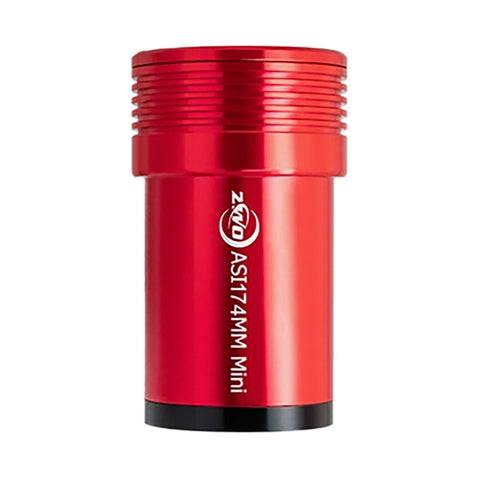
The ZWO ASI174MM Mini is a monochrome guide camera built for off-axis guiding on long focal length telescopes. It watches a star picked off by an off-axis guider (OAG) or seen through a guide scope and tells the mount how to correct its tracking many times a minute, so your stars stay round. Its 1/1.2" sensor has 1936 x 1216 pixels of 5.86µm, a peak QE of about 77% and read noise of 3.5e, in the same 36mm x 61mm body as the other ZWO Minis.
Key specs: 1/1.2" Sony IMX249 mono sensor (11.3 x 7.1mm) · 1936 x 1216, 5.86µm pixels · read noise 3.5e · QE about 77% · full well 32,000e · 12-bit ADC · USB-C (USB 2.0) and ST4 · 1.25" barrel · 60g

What it does for your images
- Finds guide stars behind an OAG: an off-axis guider sees only a tiny slice of sky at the edge of your main telescope's light path. A larger sensor means more of that slice, and more stars to choose from.
- No flexure on long scopes: guiding through the main telescope with an OAG removes the small shifts between a separate guide scope and an SCT or RC that cause stretched stars.
- Round stars in long exposures and dithering: with the ASIAIR or PHD2 it corrects tracking errors and shifts the frame slightly between exposures to clean up walking noise.
- Sun and Moon snapshots: the large mono sensor and 5.86µm pixels can record the full disk of the Sun through a solar telescope or the Moon in a single frame. At about 18 fps over USB 2.0 it suits stills and mosaics rather than fast lucky imaging.
How it works with an off-axis guider
Mount the OAG between your focuser or reducer and your imaging camera, slide the ASI174MM Mini into the OAG's 1.25" holder, and focus the guide camera once by sliding it in or out. Then connect the USB-C cable to your ASIAIR or computer, calibrate, and start guiding. The ST4 port can send corrections straight to the mount, though most setups now guide over the mount's USB connection.
Here's how the three ZWO Mini cameras compare on an 8-inch SCT at its native 2032mm focal length:
- ASI174MM Mini: 19.1' x 12.0' field at about 0.59 arcseconds per pixel
- ASI220MM Mini: 13.0' x 7.3' field at about 0.41 arcseconds per pixel
- ASI120MM Mini: 8.1' x 6.1' field at about 0.38 arcseconds per pixel
That's more than twice the sky area of the ASI220MM Mini, which is often the difference between a solid guide star and none. With the 0.7x reducer (about 1422mm), the ASI174MM Mini's field grows to 27' x 17' at 0.85 arcseconds per pixel.
In a guide scope it works too: with the ZWO 30F5 (150mm) it sees a 4.3° x 2.7° field at about 8.1 arcseconds per pixel. For refractors under about 750mm, though, the less expensive ASI220MM Mini is the better match in a guide scope.

What to add for the best results
- ZWO Large OAG off-axis guider (or a guide scope, required): its 12mm prism is a good match for the ASI174MM Mini's 11.3mm-wide sensor.
- ZWO OAG off-axis guider: the standard OAG for smaller imaging sensors and shorter back-focus setups.
- ZWO ASIAIR Plus 256GB: runs guiding, your main camera and the mount from your phone.
- ZWO 30F5 Mini Guide Scope: if you'd rather guide with a separate scope on a shorter refractor.
ASI174MM Mini vs. other ZWO guide cameras
| ASI120MM Mini | ASI220MM Mini | ASI174MM Mini | |
|---|---|---|---|
| Sensor | 1/3" AR0130 | 1/1.8" SC2210 | 1/1.2" Sony IMX249 |
| Sensor size | 4.8 x 3.6mm | 7.68 x 4.32mm | 11.3 x 7.1mm |
| Resolution | 1280 x 960 | 1920 x 1080 | 1936 x 1216 |
| Pixel size | 3.75µm | 4µm | 5.86µm |
| Read noise | 4.0e | 0.6e | 3.5e |
| With the 30F5 (150mm) | 1.8° x 1.4°, 5.2"/px | 2.9° x 1.6°, 5.5"/px | 4.3° x 2.7°, 8.1"/px |
| Best for | Budget guiding with short guide scopes | Most guide scopes, and OAGs on refractors | OAGs on long focal length SCTs and RCs |
See all ZWO guide cameras and autoguiding gear.
What's in the box
- ASI174MM Mini camera
- 1.25" cover
- 1.25" extender
- M28.5 to CS adapter
- ST4 guide cable
- USB 2.0 Type-C cables, 0.5m and 2m
- Quick guide

The off-axis guider or guide scope is sold separately.
ZWO ASI174MM Mini FAQ
Do I need the ASI174MM Mini, or will the ASI220MM Mini do?
If you guide with a guide scope on a refractor, the ASI220MM Mini is the better value. Choose the ASI174MM Mini when you use an off-axis guider on a long telescope, such as an 8-inch or larger SCT or an RC, where the bigger sensor and larger pixels make finding a guide star much easier.
Is it good for beginners?
Yes, once you're at the stage of guiding a long focal length scope. Setup is the same as any ZWO Mini: focus it once in the OAG, select it in the ASIAIR or PHD2, calibrate and guide. Focusing the guide camera on an OAG the first time takes a little patience, and we're happy to help.
Can I use it for solar or lunar imaging?
For single frames and mosaics of the Sun (with a proper solar telescope or filter) and the Moon, yes. Its USB 2.0 connection limits it to about 18 frames per second, so for high-frame-rate lucky imaging of the Sun, Moon and planets a USB 3.0 planetary camera such as the ASI585MC is the better tool.
Does it work with the ASIAIR?
Yes. Plug it into one of the ASIAIR's USB ports and select it as the guide camera.
Which off-axis guider should I use?
The ZWO Large OAG has a 12mm prism that suits this camera's sensor. With the standard ZWO OAG, the ASI174MM Mini works too, though part of the sensor may sit outside the prism's light.
Specifications
| Sensor | |
|---|---|
| Sensor | Sony IMX249, monochrome CMOS (global shutter) |
| Format | 1/1.2" (11.3 x 7.1mm) |
| Resolution | 1936 x 1216 (2.3MP) |
| Pixel size | 5.86µm |
| Performance | |
| Read noise | 3.5e |
| Peak QE | About 77% |
| Full well | 32,000e |
| ADC | 12-bit |
| Frame rate | 18.4 fps at full resolution |
| Exposure range | 32µs to 2000s |
| Physical and connections | |
| Interface | USB-C (USB 2.0) |
| Guide port | ST4 |
| Barrel | 1.25" |
| Protective window | AR-coated |
| Back focus | 8.5mm |
| Size | 36mm diameter x 61.2mm |
| Weight | 60g (2.1oz) |
| Warranty | 2 years (ZWO) |
| Model / SKU | ZWO-ASI174MINI |